What Equipment Do I Actually Need to Start a Podcast?
The question is deceptively simple. The answer, research suggests, is not what the gear guides want you to believe.
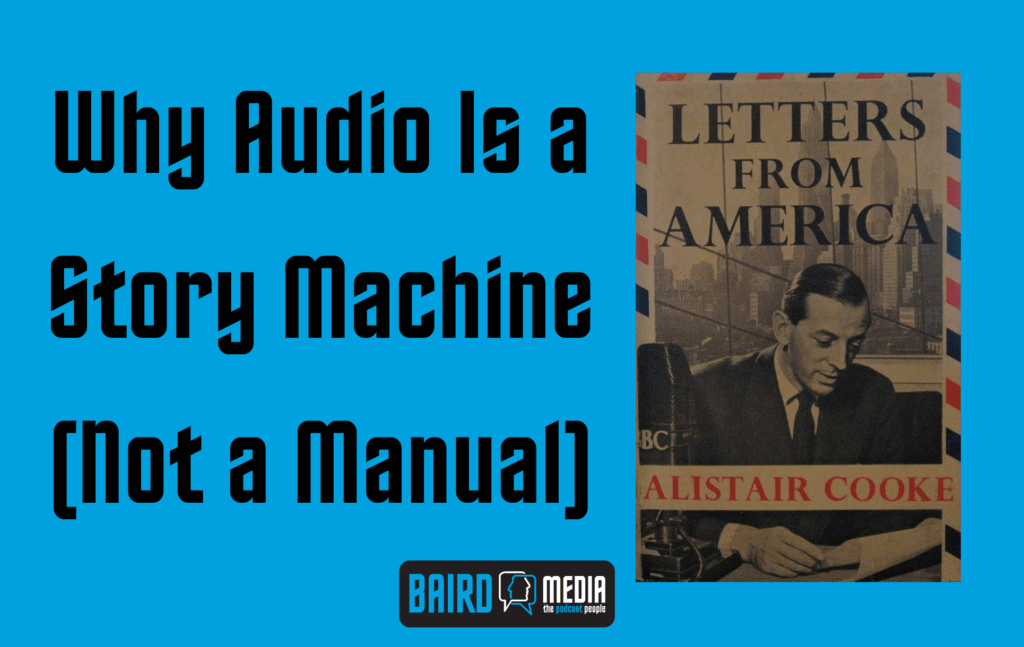
My friend Thomas and I were talking about Letter from America — that weekly BBC monologue by Alistair Cooke, from 1946 all the way to 2004. Listening to some of the episodes, it struck me how Cooke never delivered a policy memo. He didn’t lecture you about trade, austerity, or culture. He showed you people waiting for nylon, ship decks in fog, cabs idling in broken gear — and from those scenes, you felt and understood.
That, to me, is the secret of audio: it’s a storytelling engine. It transports. It conjures mental life. It persuades by letting you live a moment, not by making you nod along to a logical chain. In this article I want to argue (and illustrate) that audio does its best when it tells stories, not when it teaches abstractions.
Scholars call one of the key mechanisms in storytelling narrative transportation: a psychological state in which a listener’s (or reader’s) mental resources are deeply absorbed in the narrative. Their attention, imagery, emotions, all lean toward the events unfolding. Once you’re transported, you don’t listen to the story so much as inhabit it. You feel like you’re there.
Neuroscientific and cognitive research shows that stories (especially those richly detailed) activate brain networks used for encoding experience, empathy, memory. That’s one reason stories imprint better than bullet lists of facts. In audio, that’s gold: you don’t have the luxury of visuals. You need to use voice, tone, ambient hints, pacing, and contrast, to pull someone in.
Cooke understood this intuitively. Over 2,869 broadcasts, he built trust and expectation. Listeners tuned in because they sensed a voice that would walk them through a week in America — in speech rhythms, small vignette, reflective asides.
It’s important to note that narrative transportation doesn’t require fiction. True stories, well told, can transport you just as far (sometimes further) because you sense the stakes. The emotional connection isn’t fictional distance, but relational closeness.
When I dissected the transcript of one of the episodes, what stood out was this: the “argument” is mostly implied. The business of rationing, postwar shortage, or shifting demographics emerges through detail.
Cooke doesn’t say, “This is how austerity works.” He opens with ship decks in fog, with queues of women clutching orange tickets, with taxis failing to reverse down Fifth Avenue. These are not filler; they are the argument in action. You emerge understanding systems because you have lived friction.
Look at this:
“The smoke from the lower river was thick as fog, the engines’ roar half hidden… the docks’ cranes stood skeletal against the dawn. In the café behind me, the coffee tasted weak — sugar still rationed.”
(paraphrase)
You feel the cost: the air, the taste, the city breathing hard. You don’t need a bullet point.
That’s how Cooke works: he layers in a detail, pauses, wanders off to another detail, loops you back to the theme. He lets your mind fill in the connective tissue — often more powerfully than if he had spelled it out.
One practical lesson: if your episode has a big idea (e.g. “how climate finance leaks funds”), begin with someone’s journey, or a single painful decision, or an unremarked moment. Then thread the facts back into that story. Because when your listener is “in” the story, they let the idea in.
This isn’t to say you can never explain in audio — but from experience and design, you quickly run into friction. Abstract definitions, flowcharts, dense metrics — these things fight the ear. Your listener can’t “see” your slide.
Think of a professor who describes a network diagram verbally. The listener says, “Wait, go back, what node connects to which?” But if instead you show a person navigating that network in action — “Carol routed through Johannesburg, lost link, switched to Mombasa, and that rerouting cost her latency” — you’ve done the same conceptual work, but the listener sees it mentally.
Cognitive load theory warns us: when a listener has to keep too many elements in memory (names, relations, exceptions), the audio channel overloads. The abstract runs into the forgetting curve. But narratives chunk complexity into causal flows. You hear cause → consequence → tension → resolution, and your brain handles the rest.
This is why in podcast education or “explainer” shows, many creators layer a companion blog post or PDF with diagrams. Audio delivers the human, the emotion, the path. The visuals carry the scaffolding.
Here’s a working recipe — or set of guardrails — I use in my own Baird Media work:
a) Start with a lived scene
Open with a moment: someone arriving, someone waiting, something broken. That is your hook and your anchor. Do not start with the abstract (“Today we talk about leakages in governance”). Start with a moment of tension or surprise.
b) Introduce a character or POV you care about
Even if your “character” is composite or implied, give them desires, obstacles. Let the listener side with them. That invests emotional stakes.
c) Let facts emerge, don’t dump them
Weave in data or policy details as needed, but let them grow organically. Use contrast (“Then — vs — Now”), repetition (echo earlier imagery), turning points (“But then…”), and voice inflection to flag pivots.
d) Honor pacing, silence, and inference
Don’t rush. Use silence or pause to let the listener reflect. Give them time to imagine. Sometimes what you don’t say is as powerful as what you do.
e) Close with a moment and a clue
Bring the narrative arc to a closure — but leave a brushstroke of what is next. A listener should emerge satisfied but curious. Then, if you have a concept or call-to-action (CTA), layer it in at the end — ideally linked to a text or visual support.
f) Use supplementary media where needed
If you must show a diagram, host it on your site. Link it in show notes, embed images in blog posts, or provide a downloadable cheat sheet. Foil the tension between audio and abstraction by letting the other medium carry what audio cannot.
I imagine a South African version called Letters from SA — not a lecture on economics, but a reflection from, say, Soweto, or the Karoo, or in the back of a minibus taxi. The opening would show a passenger watching the hills outside, smelling diesel, hearing a radio crackle, and gripping a scrap of newsprint. From there, the structural argument about inequality, supply chains, energy, or culture would grow through lived detail.
In your next episode, you could try this: pick a single week in a township, record a short walk, interview one person, notice one small object (a fume pipe, a discarded charger, a broken plug). Let that be your entry promenade. And from there — not harsh lecture — weave in data, context, critique.
Because here’s what I keep returning to: when listeners live a moment, they own the idea.
And this is what makes audio special. It doesn’t tell you “how it works.” It lets you feel “how it felt,” and through that, understand.
I believe the power of audio lies less in the voice itself, and more in the world that voice evokes. Cooke’s magic was never just his tone — it was that you entered America through his lens. In his first letter, you smelled the docks, heard the queues, felt the tightness of scarcity.
If your podcast wants to move people and not just inform them, it must summon worlds, not bullet points. Every module, every concept, every “lesson” you embed must be lived first. Then you can teach.
Your voice is your brand. Your podcast should sound like it.
We help creators, coaches, and businesses make shows that stand out – for the right reasons.
Book a free consultation and let’s build something powerful.

The question is deceptively simple. The answer, research suggests, is not what the gear guides want you to believe.

Branded podcasts in South Africa are the most underused content strategy for corporates. Here’s why the opportunity is real — and why now is the time.

And what South African podcasters need to do about it — right now

The algorithm decides who gets heard — and it’s not listening to your content. Here’s what it’s actually paying attention to.

Platform dependency threatens podcast sovereignty. Learn why African podcasters need digital independence, the risks of algorithmic colonialism, and how to build owned media infrastructure.

Netflix has signed exclusive video-only deals with major podcast networks, removing full episodes from YouTube and placing them behind a subscription paywall with no RSS distribution. For South African podcasters already struggling with small markets, high data costs, and platform dependency, this marks the final stage of podcasting’s transformation from an open ecosystem into extractive digital real estate controlled by global gatekeepers.
© Baird Media 2026