Baird Media Black Logo with yellow dot
Baird Media blog article the rise of the ai factory should you be worried

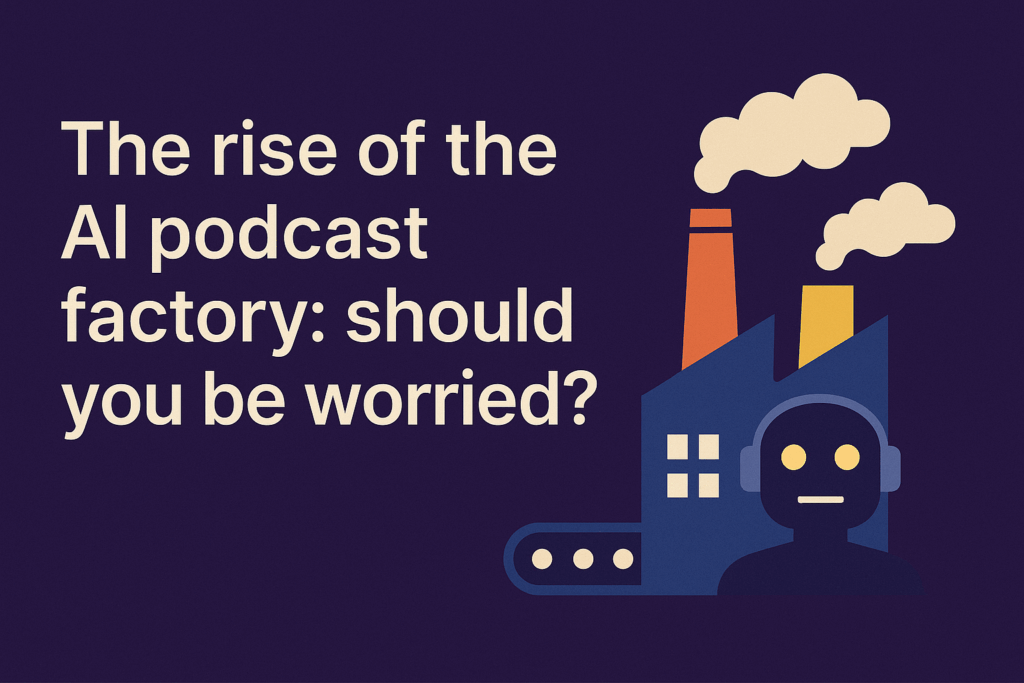
The rise of the AI podcast factory: Should you be worried?

This is Part 1 of our three-part series on AI and podcasting. In Part 2 we explore the tools podcasters can actually use to their advantage, and in Part 3 we explain why the human voice matters more than ever.

Not that long ago, starting a podcast felt like rolling up your sleeves for a craft project. You had to find a story, wrangle guests, figure out which mic wouldn’t make you sound like you were talking from a tin can, then spend hours editing out coughs and awkward silences. It was messy, frustrating, and gloriously human.

Now we’re in a different world. A company called Inception Point AI is reportedly churning out more than 3,000 podcast episodes every single week. They’re doing it with a handful of people, some servers, and clever automation. Each episode costs about $1 to make roughly ZAR 175). Once they’re uploaded, programmatic advertising kicks in, and the company turns a profit if even twenty listeners stumble across an episode.

If you’re the kind of podcaster who pours time and heart into every show, this can feel a bit like turning up at the local market with your lovingly baked sourdough, only to discover that someone’s parked a truck next to you and is giving away free factory bread by the kilo.

So the question is obvious: should you be worried?


What AI is doing in podcasting right now

The hype headlines grab attention, but by now we all know that AI has already become stitched into the fabric of podcasting.

  • Scripts – AI can generate a 20-minute “conversation” between two synthetic voices at the click of a button. No guest bookings, no scheduling headaches, no awkward pauses.

  • Editing – Tools like Descript, Auphonic and Adobe Podcast strip filler words, clean background noise, and even replace botched words by cloning your own voice. Editing that once took hours now takes minutes.

  • Translation – Spotify is experimenting with cloning podcasters’ voices into other languages, so a host recorded in English suddenly “speaks” fluent Spanish or Hindi.

  • Discovery – Platforms are leaning hard into machine learning. Apple now auto-transcribes episodes into searchable text, while Amazon Music has an AI-curated “Topics” feature that helps listeners surface shows around themes.

AI now touches every stage of the podcast process – from the idea in your head to the moment a listener presses play.


The promise and the problem

On the surface, this all sounds fantastic. Who wouldn’t want quicker edits, wider reach, and smarter transcripts? For many solo podcasters juggling production with a day job, these tools look like a lifeline.

But the very same technology that saves time is also enabling factories to flood the market with shows that don’t care about depth or connection. Instead of a few hundred thoughtful podcasts being released each week, directories are filling with thousands of fast-food episodes – easy to make, easy to forget.

This is the podcast version of the old content farms that once clogged Google with shallow, keyword-stuffed articles. Only now it isn’t text about “10 ways to clean your microwave”, it’s voices chatting blandly about wellness tips or generic business advice.


Why this matters for real podcasters

If you’re creating a show because you believe in your story, your mission, or your community, you might shrug and say: let the robots have their fun, I’m not in competition with them.

There’s some truth to that – but two challenges can’t be ignored:

  1. Discovery gets harder. With thousands of AI-generated episodes landing in directories every week, the noise floor rises. Your handcrafted podcast has to fight harder for attention.

  2. Trust is at stake. If voices can be cloned and conversations faked, how does a listener know whether what they’re hearing is authentic? Podcasting has always thrived on intimacy – that feeling that the host is really sitting with you. If that trust is shaken, the whole medium suffers.


Why most AI shows fall flat

There’s an irony here. While factories can pump out thousands of episodes, most of them are painfully dull. They’re technically sound but hollow – the audio equivalent of plain rice cakes.

That’s because podcasting was never just about information. People don’t return week after week for facts they could Google. They come back for the voice, the laugh, the stumble, the way a guest suddenly shares something raw and unexpected.

AI can imitate tone, but it can’t bring lived experience. It doesn’t know what it feels like to sit at a kitchen table at 2am editing because the interview mattered to you. And that gap – the messy, human bit – is where the magic lives.


Platforms are starting to react

It’s not only creators who see the risks. Platforms are moving fast:

  • Apple now asks podcasters to disclose if their shows are “materially generated” by AI, and has rolled out transcripts in over 11 languages to improve discovery.

  • The FCC in the US has banned AI voices in robocalls, signalling a wider clampdown on deceptive synthetic audio.

  • The RIAA is suing AI music companies Suno and Udio for training on copyrighted material – a warning shot to podcasters using AI-generated music.

  • YouTube and Adobe are introducing “content credentials” that tag whether a piece of media is authentic or AI-made.

So while the tools are racing ahead, there’s also a tug of war to keep trust intact.


What you should – and shouldn’t – worry about

Let’s bring this down to earth.

  • Don’t panic about AI stealing your whole identity just yet. Yes, cloning exists, but your specific blend of accent, timing, and life experience is still hard to fake.

  • Do pay attention to discoverability. The flood of shows makes it more important to build loyal communities and use word-of-mouth rather than leaning only on algorithms.

  • Don’t assume editing is a dead profession. AI clears grunt work, but human judgement about pacing, tone, and emotion is still essential.

  • Do consider transparency. Let listeners know when you use AI – not as a gimmick, but to build trust.


The real opportunity

Every time technology floods a creative space, the middle falls out. The easy, cookie-cutter stuff gets automated, leaving two extremes:

  1. Mass-produced sludge – cheap, forgettable, disposable.

  2. Deeply human work – original, specific, emotional, irreplaceable.

That’s the fork in the road for podcasters today. AI won’t kill the medium. What it will do is force creators to double down on the very thing machines can’t replicate – human connection.


Final thought

Back at the market, the guy with the truckload of factory bread will sell a few loaves. But the queue that forms week after week is for the baker whose bread tastes of time, care, and hands that kneaded the dough.

Podcasting works the same way. AI can flood the shelves with endless loaves. The future belongs to those who make bread worth sharing.

Don’t let your podcast get lost in the noise. Let’s build something that cuts through – book a free strategy call at http://bit.ly/4njazMK.


Podcasts Don’t Make Themselves - But We Can Help

Your voice is your brand. Your podcast should sound like it.
We help creators, coaches, and businesses make shows that stand out – for the right reasons.
Book a free consultation and let’s build something powerful.

👉 Book a Session

Share the Post:

Related Posts