

What Is a Podcast RSS Feed and Why Does It Matter?
Your RSS feed is what makes your podcast portable, distributable, and genuinely yours. Here’s how it works — and why it matters more than most beginners realise.
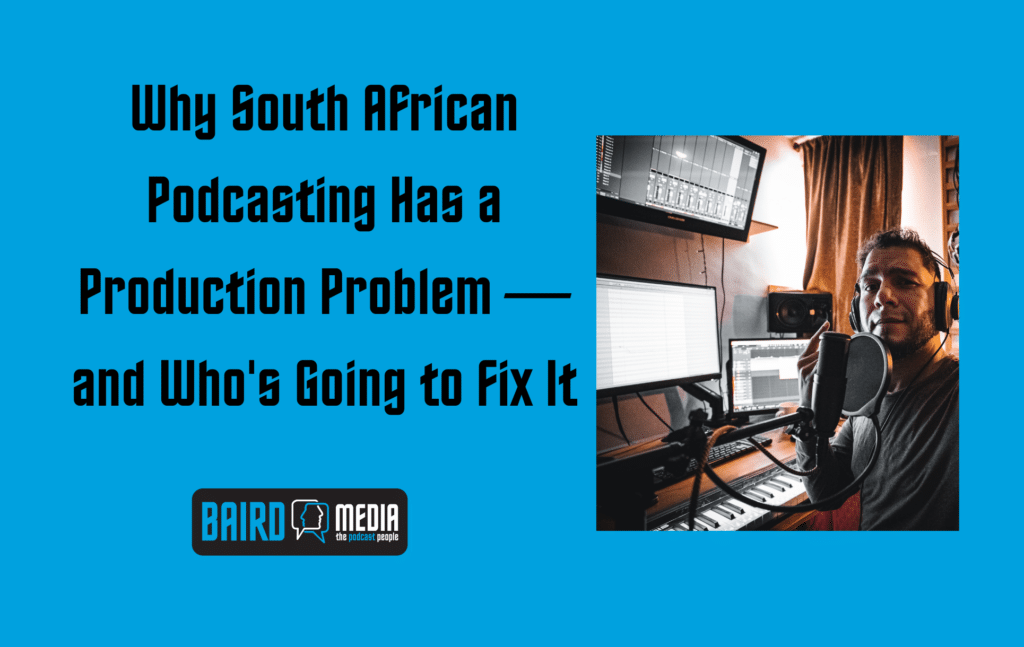
There is a moment that anyone serious about South African podcasting has experienced. You are listening to a local show — the kind where the host clearly knows what they are talking about, where the conversation goes somewhere real, where the cultural specificity is exactly what makes it worth your time. And then something in the audio shifts. A room noise intrudes. Levels jump. The edit cuts awkwardly across a sentence. And you feel the gap.
That gap is not a talent problem. South Africa has no shortage of people with things worth saying and the on-mic intelligence to say them. The gap is structural — a production deficit built into the conditions under which most South African podcasters are working. Naming it honestly is the first step toward fixing it.
Production quality is not just an aesthetic preference. It is a credibility signal. Research on listener behaviour consistently shows that audio quality in the first two to three minutes of an episode functions as a proxy for the reliability of the content itself. Listeners who encounter muddy audio, inconsistent levels, or a noisy recording environment are more likely to conclude — unconsciously — that the show is amateur, that it probably will not keep going, and that investing attention in it carries risk.
This is especially damaging for South African podcasters operating in a global attention economy. A Johannesburg-based finance show competing for the same listener as a mid-tier US podcast does not get to fail on production in the opening minutes and recover on content quality alone. The credibility window is narrow.
The political economy of this matters. Production quality has always functioned as a capital barrier in media — a way that well-resourced producers signal legitimacy and filter out entrants who cannot afford to match their standard. In global podcasting, where the dominant frame of reference is still the US market, South African shows are being measured against a production standard that assumes infrastructure South Africa does not uniformly have.
The problem has been misdiagnosed. The conversation in South African podcasting circles tends to focus on individual shows and their choices — get a better microphone, treat your room, edit more carefully. That advice is not wrong, but it addresses symptoms. The actual diagnosis is structural, and it has three interlocking causes.
First: there is no established training pipeline for podcast-specific production skills. In the United States and United Kingdom, podcasters emerge from a dense ecosystem of radio training, journalism schools, audio drama communities, and broadcast apprenticeships. Many carry production knowledge from adjacent industries that translate directly. South Africa has versions of this, but they are fragmented, expensive relative to average incomes, and not oriented toward what podcast production specifically requires. The result is a shallow talent pool for hire. You cannot easily find a freelance audio editor in Pretoria the way you can in Manchester or Chicago — because the pipeline that would produce one has not matured.
Second: the economics of professional production help are broken at both ends. For production companies to build sustainable businesses serving independent podcasters, those podcasters need to be able to afford professional help. For independent podcasters to afford professional help, the production economy needs to be developed enough to keep rates manageable. This is a classic chicken-and-egg problem, and South Africa is stuck in the middle of it. Most shows operate on budgets that cannot support professional post-production. Most professionals cannot build a business on what those budgets allow. So both sides manage without each other, and the quality ceiling stays where it is.
Third: the physical infrastructure of good production carries costs that are not distributed equally. Load-shedding disrupts recording schedules and complicates post-production workflows that rely on cloud-based tools. Data costs — South Africa spends an estimated 62% of digital media budgets on connectivity compared to a global average of 40% — make cloud-based production pipelines more expensive to run. Foreign exchange rates make professional microphones, interfaces, and acoustic treatment genuinely inaccessible for many independent creators. These are not excuses; they are conditions. And they explain why the average production quality of the South African podcast field sits where it does, independent of the talent available within it.
The consequences of the gap extend beyond any individual show. They compound across the ecosystem.
Shows with genuinely important voices and stories do not reach the audiences they deserve because production quality creates a first impression listeners do not push past. The show about navigating South African healthcare as a black professional, the Cape Town-based true crime podcast, the Afrikaans business show with a regional audience no international podcast can serve — these shows carry a cultural value that money cannot manufacture. But listeners encountering them through a global platform make their decisions in seconds, using production quality as their first and fastest filter.
The knock-on effect is commercial. Brands and organisations that might sponsor or commission local podcasts are calibrating their expectations against international shows. When the average quality of the local field does not meet that benchmark, they either import content, commission internationally, or do not commission at all. The budgets that could support the ecosystem development the ecosystem needs flow elsewhere.
And the creators who might have built the knowledge base for the next generation — the editors, producers, showrunners — get frustrated and leave. Not because they lacked the skill. Because the conditions made the work unsustainable.
The honest answer is that no single actor closes this gap. But several categories of players are positioned to move it, and understanding which is which matters.
Community organisations like the South African Podcasters Guilddo the work that no production company can replicate: building norms, facilitating peer critique, creating access to knowledge across income levels. The guild model functions as the connective tissue of the ecosystem — shared standards, mentorship, peer accountability. What it cannot do alone is solve the economic problem or replace formal training pathways. But it is the foundation on which everything else needs to build.
Independent educators and creators who document their process are underutilised in South Africa. There is a class of podcaster internationally — the ones who share their workflow openly, who publish what they have learned from failure, who treat knowledge transfer as part of their practice — who have meaningfully raised the floor of production quality in their markets. South Africa has the people who could do this. The culture around doing it is underdeveloped.
Production companies that treat training as infrastructure, not just service, are the category most directly positioned to close the gap. The argument for this is not sentimental. It is structural. A production company that operates at the intersection of professional production and education builds the training pipeline the industry lacks, creates the portfolio of well-produced work that raises the perceived standard of the local field, and demonstrates to brands and commissioners that South African podcast production can be genuinely excellent. When production companies invest in what the ecosystem needs — not just what individual clients are currently paying for — the whole field moves.
Brands and organisations that commission podcasts carry more responsibility here than they typically acknowledge. Commissioning a podcast with a budget that cannot support professional production, and then expressing disappointment with the result, is not a market signal — it is a self-fulfilling condition. The organisations that will benefit most from a healthy South African podcasting ecosystem are the same ones whose commissioning decisions, right now, are either feeding or starving it. Quality expectations require commensurate investment. There is no route around that.
There is a version of this story that ends pessimistically. The infrastructure gaps are real. The economic conditions are difficult. The international benchmarks are not moving to meet South Africa where it is.
But infrastructure problems are solvable in a way that talent deficits are not. And South African podcasting does not have a talent deficit. It has creators with genuine cultural specificity, subjects that no globally-produced show can address with the same authority, and a community that is increasingly serious about its own standards. The production gap is not evidence of a field in decline. It is evidence of a field that has grown faster than the supporting structures around it.
The people who close this gap will not just be the ones who produce better shows. They will be the ones who make it possible for everyone else to.
Your voice is your brand. Your podcast should sound like it.
We help creators, coaches, and businesses make shows that stand out – for the right reasons.
Book a Free Strategy Session and let’s build something powerful.
Your RSS feed is what makes your podcast portable, distributable, and genuinely yours. Here’s how it works — and why it matters more than most beginners realise.

South African podcasting has a production problem — but it isn’t a talent problem. It’s structural. This Industry Insights analysis examines why the gap exists, what it costs the ecosystem, and who is positioned to close it.

Audio and video podcasting are converging. Here’s how South African brands can choose the right format — or combine both — for maximum impact.

Showmax is closing. The audience it served hasn’t gone anywhere. Here’s what South African brands and commissioners should be thinking about next — and what a professionally produced podcast series actually costs to commission.

The question is deceptively simple. The answer, research suggests, is not what the gear guides want you to believe.

Branded podcasts in South Africa are the most underused content strategy for corporates. Here’s why the opportunity is real — and why now is the time.
© Baird Media 2026